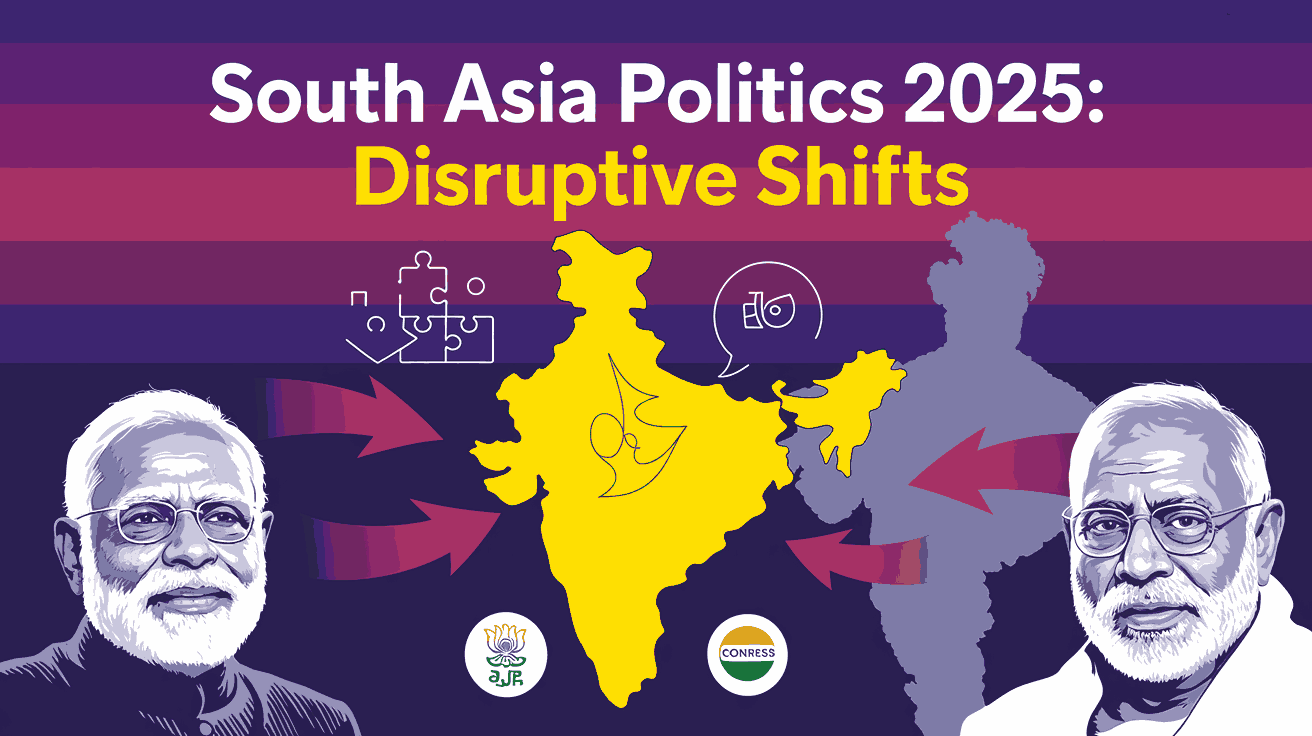
The year 2025 is going to be a crucial moment for India and South Asia. Political dynamics are changing quickly, existing alliances are being shifted, and the respective roles and influence of regional and global powers are changing. The region is feeling disruptive change – from coalition government in India, to increasing youth activism in Bangladesh and Nepal – that can change the future of the region. Policymakers, investors and citizens will need to understand these dynamics as they navigate a rapidly changing South Asia.
India’s New Coalition Era
Following the 2024 national elections, Prime Minister Narendra Modi (BJP) no longer commands a legislative majority, thereby needing to rely upon regional NDA partners. This phase of coalition governance created a complex new power-sharing arrangement –
- Major policy concessions had been necessitated to placate regional parties such as Janata Dal (United) and the Telugu Desam Party.
- Cabinet reshuffles and the creation of special ministries have displayed new patronage to ideologically friendly partners such as the RSS.
- While demands for billions of funding allocations from regional leaders clearly indicate their new bargaining power, they also showcase the limits of Modi’s leadership style and political strategy, as well as long-term plan for the country.
The coalition era has also altered legislation priority given that many bills focused on development have not only been significantly delayed or entirely restructured, but instead introduced to accommodate new regional interests.
Regional Instability and Youth Movements
South Asia’s smaller nations are witnessing significant political and economic flux are –
- Bangladesh: With Sheikh Hasina exit, Dhaka is navigating a more balanced foreign policy while China’s economic influence grows through infrastructure and trade initiatives.
- Nepal: Economic struggles and IMF-backed reforms coincide with increasing youth activism demanding political reform and better representation.
- Sri Lanka & Myanmar: Both countries face economic instability and governance challenges. while political unrest remains high.
These developments challenge India’s traditional hegemonic influence in South Asia. Smaller nations are increasingly diversifying partnerships toward China, seeking economic and strategic security beyond India.
China Expanding Influence
China footprint in South Asia has deepened dramatically in 2025 –
- In Pakistan, the China-Pakistan Economic Corridor (CPEC) continues to drive infrastructure investment and strategic leverage.
- In Myanmar, China is supporting both government and ethnic militias, strengthening its regional bargaining position.
SAARC – once a forum for regional cohesion, is increasingly sidelined as bilateral deals with Beijing gain prominence. For India, this underscores the need to shift from interventionist policies toward partnership-based diplomacy, emphasizing mutual respect and collective stability.
Politics and Social Fault Lines Within India
Domestically, Modi’s government faces renewed opposition –
- The Congress party, rejuvenated under Rahul Gandhi, is uniting Dalits, Muslims, and lower-caste groups around issues of minority rights, job quotas and social justice.
- Rising inflation and underemployment exacerbate social divides challenging federal authority.
- Upcoming state elections in Delhi and Bihar will test opposition unity and government stability ahead of the 2029 parliamentary redistribution.
Internal political pressures are forcing the BJP-led government to balance economic reforms with social welfare policies carefully.
Geopolitical Balancing and India’s Global Stance
On the international stage, India is recalibrating its foreign policy are –
- Non-alignment continues, with strengthened ties to the U.S. alongside growing partnerships in Africa and Latin America.
- Regional tensions, especially with Pakistan and a changing Bangladesh leadership are testing India’s Neighborhood First policy.
- Climate change cooperation, digital transformation and defense modernization remain central pillars of India’s diplomatic strategy.
These measures aim to maintain India strategic autonomy while asserting its role as a stabilizing force in South Asia.
Conclusion
The year 2025 will be a momentous pivot point in India and its immediate neighboring states. Domestic coalition politics, social movements formed by young people, regional instability and growing influence of China creates a complex, multipolar environment. How India confronts the stresses of both internal and external pressures will shape India’s regional leadership and global significance over the next decade. For policymakers and citizens reflecting on the future, efforts to understand political and social changes is no longer optional. It is imperative.
Team By Also Author – Flame Tadka / flametadka.com
Major Political Developments in India and South Asia: 2025 Disruptive Shifts
United States-China Chip War 2025: Trade Probes and Antitrust Moves Shake Global Tech