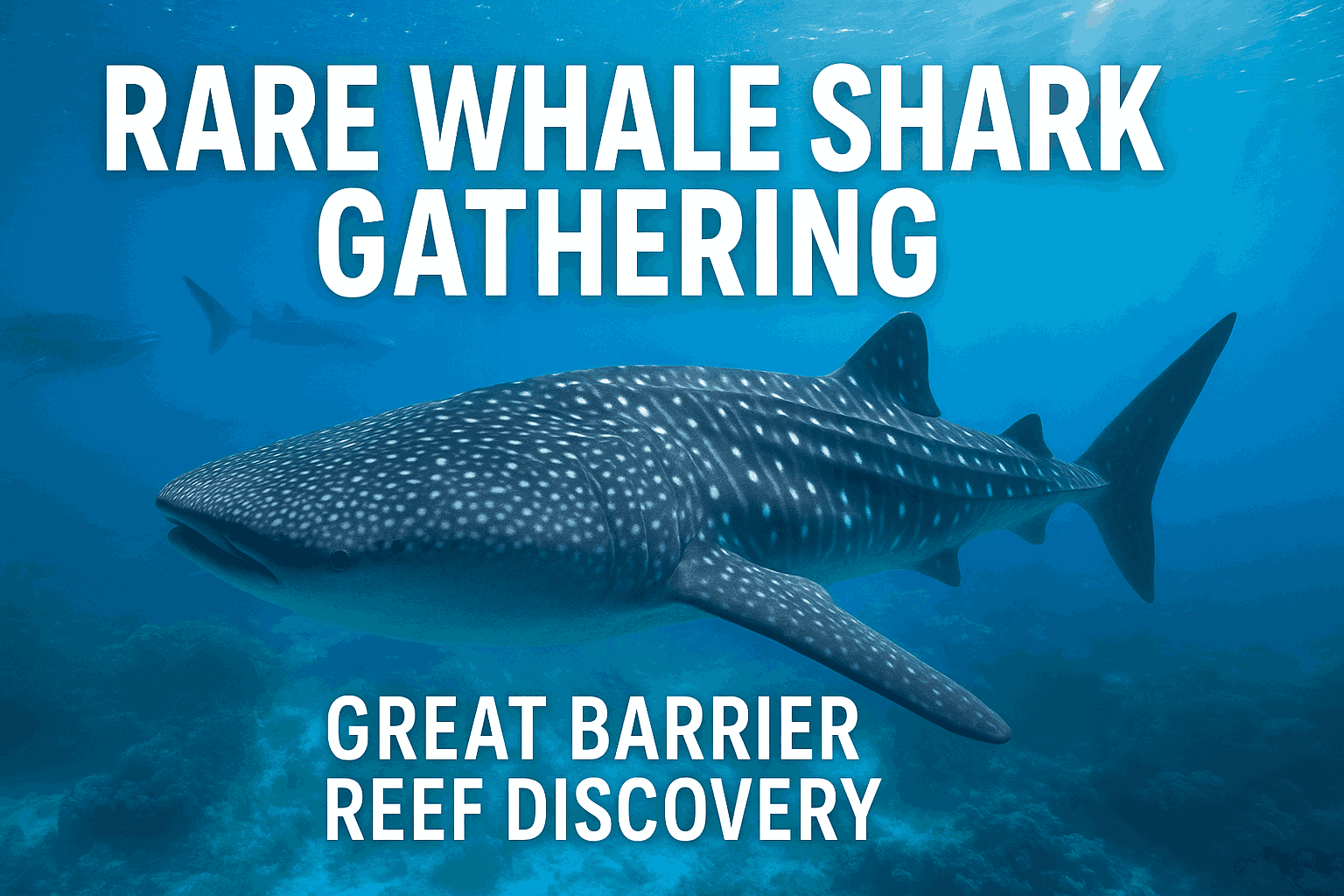
A Hidden Spectacle Beneath the Waves
Far off the northern edge of Australia’s Great Barrier Reef, something extraordinary is happening under the ocean’s surface. Wreck Bay, a remote and sacred stretch of sea, has revealed itself as a seasonal hotspot for whale sharks, the largest fish on Earth. For scientists, this is a rare and groundbreaking chance to observe these gentle giants up close, an opportunity that has long remained elusive.
Whale sharks, which can grow as long as a city bus, glide slowly with grace, their skin patterned in white spots and stripes that resemble constellations in the night sky. Despite their size, these massive creatures are harmless filter feeders, drifting through swarms of plankton while journeying thousands of kilometers across tropical waters.
Wreck Bay: A New Hub for Whale Shark Science
A recent study published in Ecology and Evolution confirms that Wreck Bay is home to a recurring congregation of mostly juvenile male whale sharks , the first known gathering ever documented in eastern Australia and across the southwest Pacific.
Between 2019 and 2024, researchers carried out four expeditions and identified 59 individual whale sharks ranging from 3.5 to 8 meters in length. While adult whale sharks can grow up to 18 meters (59 feet), it is younger males that often dominate such aggregation sites worldwide.
This finding could prove crucial for conservationists. According to lead researcher Ingo Miller of the Biopixel Oceans Foundation, the discovery provides a critical hub for tracking regional and global whale shark populations, calling it “quite significant” for long-term conservation planning.
Why This Discovery Matters Globally
Scientists used a mix of satellite tagging, historical records, and oceanographic data to trace the movements of these elusive sharks. One tagged whale shark, first seen near Cooktown, led the team to confirm Wreck Bay as a seasonal gathering point. The congregation occurs mainly in late November and December, when nutrient-rich waters rise during monsoon season, creating feeding hotspots at dusk and nighttime. Experts like Gonzalo Araujo of the Marine Research and Conservation Foundation praised the research for combining modern science with local ecological knowledge, highlighting how community observations can advance our understanding of such mysterious species.
Globally, whale sharks are classified as endangered. Their numbers are shrinking due to climate change, plastic pollution, ship collisions, and industrial fishing bycatch. Fortunately, Wreck Bay lies within one of the most protected zones of the Great Barrier Reef Marine Park, offering a rare refuge for these magnificent ocean wanderers.
Team By Also Author – Flame Tadka / flametadka.com